

Greetings, First of all ! Welcome to today’s blog on meriSIP.com Today we will talk about much underrated investment vehicle for our savings i.e. BONDS. We will cover What are Bonds? And their benefits.
What are Bonds? And its definition.

Today we will cover :-
Benefits of Investing into Them
Categories of Bonds in India
Advanatges and Disadvantages of Bonds
Ways to Invest into Them
Conclusion
1. Benefits of Investing into Them :-
These are normally seen as volatility less instruments of investing if held to maturity date (You have studied about this term above). Here are some of the common benefits that everyone should know :-
(a) Fixed Income at Fixed Intervals – Unlike equities, you actually know in advance that how much money will I recieve on so and so date. This makes them highly attracive for retirees who have some corpus but want a predictable and legible amount periodically.

(b) Capital Preservation – Although the prices changes with changes in RBI Interest rates, but it does not affect anybody who keeps them till their maturity date.

(c) Portfolio Diversification – Ideally we must have a mix of investing instruments example – Stocks, ETFs, Mutual Funds, etc. who have purpose of being into your portfolio. Also, consider them a part of you portfolio.

2. Categories of Bonds in India
There are several types of them in India, depending on the classification factor. Broadly, there are 9 classification factors that can help us segregate them:-
- Issuer
- Security
- Seniority
- Credit rating (or safety)
- Interest rate
- Maturity (or term)
- Listing
- Convertibility to stock
- State guarantee
Further, these categories have many other types. We will discuss only one here, Let’s know in comment section if you are interested into another ones.
For Example :- On the basis of Issuer. These are of two types :-
- Government
- Corporate
Government Bonds
They are issued by the state and central governments.
These are considered to be extremely safe. In fact, bonds issued by the government are sometimes referred to as ‘risk-free bonds’. This is because the government can always print money and repay debt obligations and doesn’t have to rely on anyone else.
Example of a government bond: In Jan 2023, the Govt of India issued 6.89% GS 2025, a 2-year bond with an interest rate of 6.89% and a maturity date of 16th Jan 2025.
Corporate Bonds
These are issued by corporations or companies are referred to as corporate bonds. Public and private sector companies can issue corporate bonds.
As compared to government bonds, corporate bonds are considered to be riskier. This is because the company issuing the bonds has to generate revenue and profit to be able to pay interest to the bondholders. The generation of revenue and profits is subject to many external factors that the company may not have control over.
Even within corporate bonds, PSU bonds are considered to be safer than bonds issued by private companies. This is because PSUs are owned and enjoy support from the government.
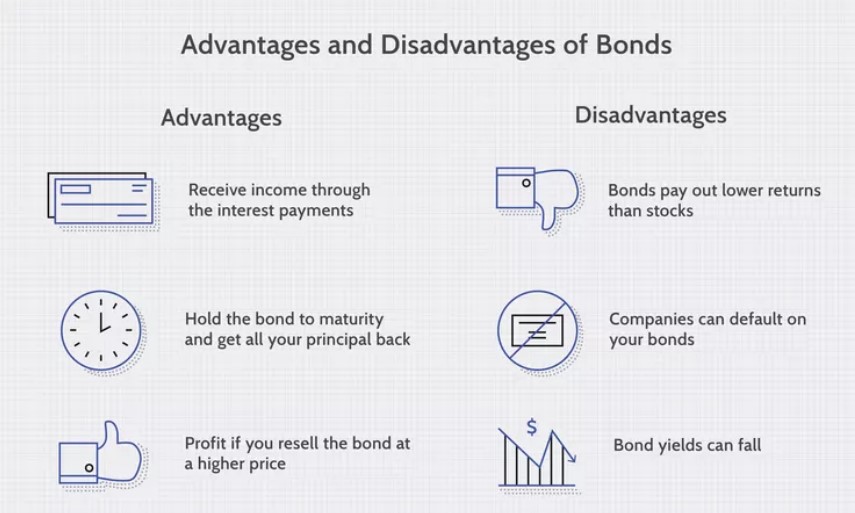
3. Advanatges and Disadvantages of Bonds :-
4. Ways to Invest into Them :-
Direct way
Choosing bonds, Companies etc on your own thorugh their websites or thorugh bonds market. It is more than riskier than the Mutual Funds way.
Through Mutual Funds
Invest in Different types of bonds depending on your risk appetite and profile.
5. Conclusion:-
Bonds do deserve a place in your portfolio, as it is something that provide you steady and predictable income. Always keep your expectations low as we hardly can increase our reality. In this way only, we can invest Happily without getting afraid of news and media. Do not hesitate to meet Mutual Funds Expert, in case you think you need one.