

Greetings, First of all ! Welcome to our post on meriSIP.com Today we will know about Who decides Gold price?.
Who decides Gold price?
Today we will cover :-
How per Kg rate of Banana is decided?
Globally Mined Gold
Spot Price (in International Markets)
Rate in India
Factors affecting God price in India
Conclusion
1.How per Kg rate of Banana is decided?
Key Takes-away from Banana Pricing
- Every commodity includes such pricing dynamics.
- Every stage matters a lot in final price.
2. Globally Mined Gold :-
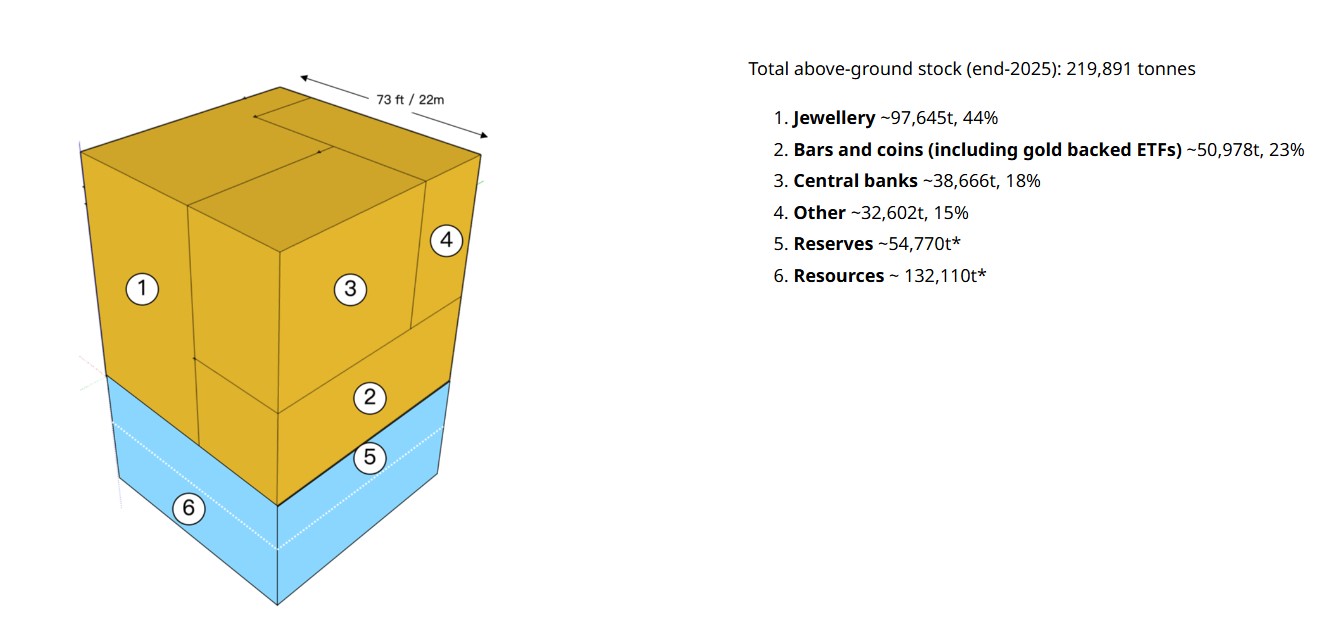
The total Gold mined or in supply till (end of 2024 estimates):-
- Jewellery – 97,645 tonnes (44% of Total Gold)
- Bars and Coins (including GOld backed ETFs – 50,978 tonnes (23%)
- Central banks – 38,666 Tonnes (18%)
- Others – 32,602 Tonnes (15%)
- Reserves – 54,770 Tonnes
- Resources – 132,110 Tonnes
- Source: Metals Focus, Refinitiv GFMS, World Gold Council
3. Spot Price (in International Markets)
Gold is a global commodity. And its base price is determined in international markets, by the London Bullion Market Association (LBMA). LBMA is an association which promote a robust, fair, effective and appropriately transparent market.
Gold price in International Markets is decided by LBMA (London Bullion Market’s Association). Internationally, the price of Gold is fixed in London daily, twice a day in two different sessions. The morning session at 10:30 AM is referred to as ‘AM Fix’ and the evening session at 3:00 PM is called the ‘PM Fix’. The prices are fixed by the gold dealers from London’s biggest bullion desk. The whole process is facilitated by Nathan Mayer Rothschild & Sons.
There are about 10-11 participating banks, which include names like JP Morgan, Standard Chartered, Scotiabank, Société Générale etc. Do note, the general public and other banks are not permitted to participate in this process. The dealers from these banks call the dedicated conference line at the designated time and submit their bids to buy and sell gold. From all the bids and offers an average price is arrived at, and the same price is relayed to the market, which then becomes the benchmark for gold trading. The whole process lasts for about 10-15 minutes. The process is again repeated in the ‘PM session’, and the gold prices are again discovered and relayed to the markets.
The gold price that is fixed by the AM and PM sessions is very close to the actual price of gold that is traded in London and other international markets. So in a sense, the price that is relayed holds no surprise to traders or bullion dealers, in fact, some participants even believe that like many things in England, even this is conducted more to keep up with tradition.
4. Rate in India
India too follows a somewhat similar practice, but less elaborate. India, being one of the biggest consumers of Gold, imports the yellow metal.
The gold is imported by designated banks (Licensed by RBI) and the banks in turn supply this gold to bullion (Gold or silver in bulk form, especially bars or ingots, valued by weight and purity, not coined or used as legal tender.) dealers (after adding the necessary charges; more on this a little later).
The Indian Bullion Association then bids for the gold through its network of bullion dealers. These dealers describe how much gold they would like to buy or sell at a given price, the rates are averaged out, and this roughly sets the floor for the Gold prices in India. Anyway, this price is relayed to the dealers’ and jewellers’ network, and the price for the day is set.
5. Factors affecting God price in India
Factors affecting Gold price in India:-
- Since international gold is priced in USD, the ₹/USD exchange rate plays a huge role:
- If INR depreciates, gold becomes more expensive in rupees.
- If INR appreciates, gold becomes cheaper, even if international prices are flat.
Example:
- Gold = $1,900/oz
- USD/INR = ₹85 → Indian base rate = ₹5,214/gm
- USD/INR = ₹82 → Indian base rate = ₹5,032/gm (Just exchange rate change can make ₹180/gm difference!)
2. Import Duties and GST levied by govt.
3. Local Demand (high during festive seasons)
Let’s take an example to understand the process:-
- Gold international = $1,900/oz
- USD/INR = ₹85
- Import duty = 15% (total)
- Local premium = ₹200/10g
Final price calculation:
1 oz = 31.1 gm → $1900 = (1900*85/31.1) rupees per gram =₹5,192 Add 15% tax = ₹5,971 Add ₹20/gm premium = ₹5,991/gm → ₹59,910 per 10 grams (24K gold price)
22K = 91.6% of 24K → ₹54,900 per 10g
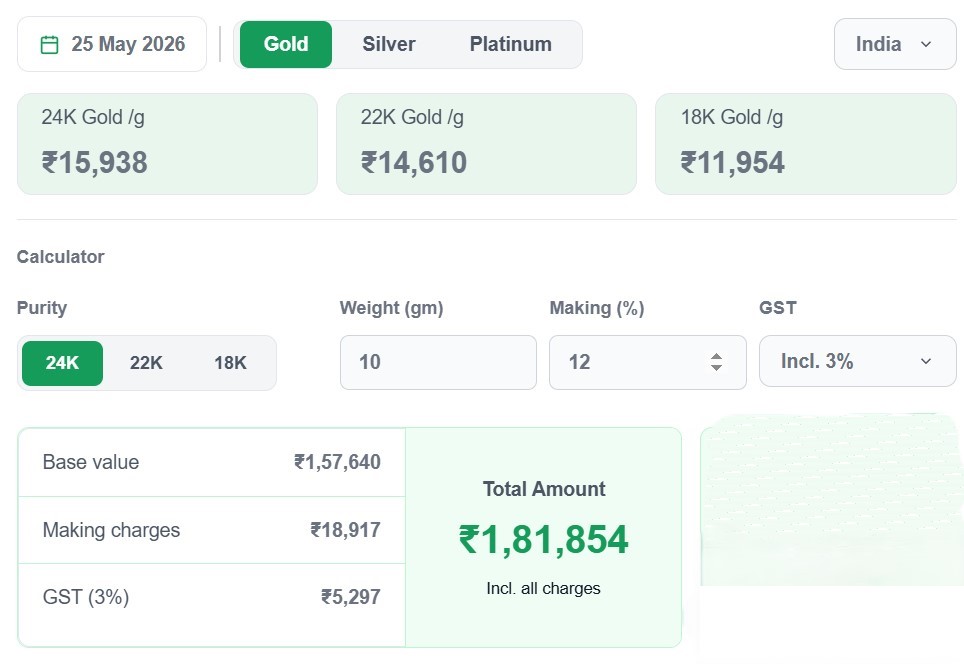
After Final price, Price paid by consumer :-
6. Conclusion:-
Thus , Gold rate is decided and recent spike in Gold prices was because the central banks were buying gold left- right and centre. Gold deserves a place in your portfolio, as it is something that provide hedge against Inflation. Always keep your expectations low as we hardly can increase our reality. In this way only, we can invest Happily without getting afraid of news and media. Do not hesitate to meet Mutual Funds Expert, in case you think you need one.